How to Safely Connect a Generator to a House
When the power goes out, the last thing you want to do is improvise. And even less so if the outage follows a storm, a power grid failure, or several hours without power. In my case, I’ve always viewed a generator as a backup solution: not to “carry on with life as usual” as if nothing had happened, but to keep the essentials of the house running without putting the electrical system at risk.
That’s the difference between doing things right and taking a shortcut. Connecting a generator to a home isn’t just a matter of plugging it in “any old way”; rather, it involves safely integrating it into the electrical circuit—typically using a transfer switch or equivalent system—while complying with applicable regulations. When done correctly, the emergency generator can supply the necessary power to the home’s essential equipment during a power outage. When done incorrectly, however, serious risks arise: backfeeding into the grid, overloads, damage to appliances, and even danger to people.
That’s why, in this guide, I’ll walk you through how to connect a generator to your home step by step, what you need to check beforehand, how to determine the right power output, why the transfer switch is a key component, and what mistakes you should avoid. I’ll also address a frequently asked question: whether it’s really a good idea to connect a generator without a transfer switch, or if that ends up costing you in terms of safety and peace of mind.
The idea is for you to finish this article with a realistic perspective. Not just theory, but the ability to discern what you can plan yourself, what an electrician should do, and what decisions make the difference between having a useful emergency system or yet another problem in the middle of a power outage.
What You Need to Know Before Connecting a Generator to a Home
Before connecting a generator to your home , you need to consider cables, outlets, and electrical panels. It’s important to understand a basic fact: a generator isn’t connected to a home like just another appliance. It’s part of a backup power system and, therefore, must be installed with a system that clearly separates the power from the utility grid from the power supplied by the generator.
This point is important for one simple reason. If both sources are connected at the same time, feedback can occur. In practical terms: the current from the generator can flow back into the external grid or circulate through the electrical system in an unintended way. This is dangerous for the home, for appliances, and also for any technician working on the electrical system who assumes it is de-energized.
Furthermore, not all homes have the same needs. In some homes, the only priority is keeping the refrigerator, a few lights, the router, a water pump, or the heating running. In others, you might also want to back up the freezer, some kitchen outlets, or an automatic door. In my case, the reason for installing a generator has always been this: to ensure the essentials are covered when the power goes out, especially after a storm or a long outage—not to power the entire house without prioritizing usage.
You also need to consider the location, ventilation, noise level, access for refueling, and the generator’s starting method. A portable generator used only occasionally is not the same as a more reliable emergency system. Nor is a single-family home with an accessible electrical panel the same as an older building with modifications accumulated over the years.
Another key point is the regulations. Although they vary by country or region, the principle remains the same: an installation of this type must be safe, properly isolated from the grid when necessary, and comply with both the electrical panel and existing safety measures. Therefore, while I’m going to provide you with a very practical guide here, there’s one aspect that shouldn’t be taken lightly: the final connection to the home’s electrical system must be inspected or performed by a qualified professional.
When Is It Worth Installing a Generator at Home?
A generator is a good idea when power outages are relatively frequent, when you live in an area prone to storms or grid issues, or when you have equipment that shouldn’t be left without power for many hours. It’s also useful in homes where a pump, a refrigerator, or certain essential systems need a continuous power supply.
I would put it this way: it’s worth it when the cost of being without power for several hours is greater than the cost of setting up a reliable backup solution. If every power outage forces you to improvise, causes food to spoil, or leaves you without essential services, then it’s no longer a luxury; it becomes a matter of business continuity.
What are the risks if you connect it incorrectly?
The most serious mistake is to improvise the connection. Among the most common risks are backfeeding, generator overload, the use of unsuitable cables, damage to sensitive equipment, and exposure to carbon monoxide due to improper placement of the engine.
There is also a very real risk that many quick guides downplay: the belief that “if it works, it’s fine.” No. A setup can power devices and still be unsafe. The key is not just that the generator supplies power, but that it does so in a controlled, isolated, and predictable manner.
How much power does a generator need to power a house?
Choosing the right generator capacity is one of the most important decisions in the entire project. And this is where people often make two opposite mistakes: buying one that’s too small “because it’s only for emergencies” or buying one that’s way too big without being clear about what it will actually be powering.
The right way to approach this is to make a list of priority power needs. Not everything in the house, but what you actually need during a power outage. For example: the refrigerator, freezer, basic lighting, router, phone chargers, a kitchen outlet, a water pump, a boiler, or heating, depending on the situation. From there, add up the power requirements and leave some leeway.
This margin is important because some equipment has startup peaks that exceed its rated power consumption. A refrigerator, a pump, or a motor-compressor does not behave the same way when starting up as it does when it is already running. If you choose a generator that is too small, it may start up fine sometimes and fail at other times, or it may be constantly overloaded. And a generator operating at its limit not only has a shorter lifespan—it also delivers less stable power.
In my experience, it makes more sense not to think, “I want to power the whole house,” but rather, “Which parts of the house do I need to keep running during a power outage?” That shift in perspective helps you avoid a lot of unnecessary purchases. Ultimately, a properly sized emergency generator provides peace of mind precisely because it’s designed to meet your needs, not to show off its power.
Furthermore, it’s not enough to simply look at the wattage figures provided by generator manufacturers. You need to distinguish between continuous power and peak power, check whether the generator is suitable for sensitive equipment, and assess how you’ll distribute the loads. If you’re going to connect your home through the electrical panel, it’s not just the generator that matters—the circuits you’ll be backing up are important too.
Difference between maximum power and continuous power
Maximum power is usually the peak output that a generator can deliver for a short period of time. Rated power is the output it can maintain steadily without straining. For residential emergency use, rated power is almost always the relevant figure.
If you base your sizing calculations solely on the maximum load, you might be in for a surprise when multiple appliances are running at the same time. For a home, it’s wise to err on the side of caution. I’d rather have a system that comfortably powers the essentials than one that’s “just enough” and fails at the worst possible moment.
Which devices should you prioritize during a power outage?
The priority is usually:
- refrigerator and freezer,
- essential lighting,
- routers and communications,
- water pump if the home relies on it,
- heating or boiler when it is critical,
- a few key contacts.
On the other hand, I would usually avoid using large, non-essential appliances during an emergency: ovens, glass-ceramic cooktops, large air conditioners, high-wattage electric water heaters, or multiple high-power appliances running at the same time. The logic is simple: safety first, comfort second.
Where to place the generator for safe use
The generator's location is not a minor detail. In fact, poor placement can turn an installation that looks fine on paper into a dangerous situation in practice. The generator must be placed outdoors or in an area that is properly ventilated; it should never be placed in living areas or in enclosed or poorly ventilated spaces.
This isn't just about "making sure it doesn't smell." It's about preventing gas buildup, overheating, and noise or maintenance issues. A generator needs to be able to breathe properly, safely vent gases, and be easily inspected. It's also a good idea to protect it from direct rain if it isn't designed for outdoor use, but without enclosing it in a space where heat and gases can accumulate.
Here, many people fall into a common dilemma: they want to keep it close to the electrical panel for easy connection, but they also want to hide it, protect it from the elements, and reduce noise. The solution shouldn’t be to stash it in a storage room, an unventilated garage, or a semi-enclosed area. The right approach is to find a safe, stable, accessible outdoor location that’s designed for its intended use.
When I think about a system like this, I always feel that the overall safety is more important than the convenience of a makeshift connection. After a storm, for example, you want the generator to start up and run without having to move it, without having to improvise with odd extension cords, and without worrying whether it’s too close to the house.
Ventilation, noise, and distance from the residence
The generator should be operated in a well-ventilated area, on a stable surface, and at a safe distance from doors, windows, and walkways. It’s also important to consider noise levels, because equipment that’s too loud tends to be used less frequently or less effectively than intended.
The key here is to combine three things: security, accessibility, and practicality. You should be able to access it quickly, check it, and use it safely.
Common mistakes to avoid
The most common mistakes are:
- use it inside the garage,
- placing it too close to a window or door,
- place it on an unstable surface,
- leave it exposed to direct rain without adequate protection,
- hide it in a corner with no ventilation because of the noise.
An emergency facility must be ready to function properly under adverse conditions. If it relies on a questionable location, it starts off at a disadvantage.
The role of the switch in the installation
If I had to summarize the technical aspects in a single sentence, it would be this: the transfer switch is the component that allows you to safely switch between the utility grid and the generator. In other words, it prevents both power sources from supplying the home at the same time and ensures that the system operates smoothly.
That’s why it appears time and again in the best guides on the subject. It’s not just a “nice-to-have” or a decorative recommendation. In many cases, it’s the heart of a safe installation. Thanks to this system, you can isolate your home from the main grid during a power outage and use the generator to power only the circuits you’ve designated.
In my case, I’ve always felt it makes more sense to connect a generator using a transfer switch and following the regulations than to look for shortcuts. It may seem like a less “quick” solution than other options floating around online, but it offers something far more valuable: control. And when it comes to electricity, control matters more than improvisation.
Depending on the installation, there may be manual or automatic transfer switches, or equivalent systems designed for load transfer. The choice depends on your budget, the level of automation you’re looking for, and the type of generator. In a residential setting, a well-designed manual transfer switch is often a perfectly reasonable solution if used in emergency situations and with a clear protocol in place.
Why do you avoid giving feedback?
Feedback occurs when current can flow back into the grid or circulate in a non-isolated manner. The switch prevents this by forcing the selection of a single power source at any given time: either the grid or the generator.
To put it more plainly: it doesn't leave the door open to a dangerous mix. That's why it's so important.
Manual, automatic, and other options
The manual switch requires user intervention. The automatic switch detects a power outage and switches over according to the system’s design. There are also solutions such as interlock kits available in certain situations, but not all homes or electrical panels are the same. Therefore, before copying solutions you’ve seen in forums or videos, it’s a good idea to check what actually works for your specific setup.
How to Connect a Generator to a House, Step by Step
Here comes the part everyone’s been waiting for: the process. And it’s best to approach it with a clear plan in mind. I’m talking about a well-thought-out, safe connection that’s ready to power the house through the right system—not just a quick fix.
1. Determine which circuits or loads you will be backing up
The first step is to decide what the generator will power. Not every part of the home needs to be included in the backup system. It is often better to select priority circuits or critical loads. This makes it easier to calculate power requirements and reduces risks.
2. Inspect the home's electrical system
Before connecting a generator, you should inspect the electrical panel, the protective devices, the condition of the wiring, and the feasibility of installing a transfer switch or transfer system. If the installation is old or has unclear modifications, this step should not be skipped.
3. Install the appropriate transfer system
This is the key point. The system must allow the grid to be disconnected and the generator to be connected without any dangerous cross-connections. In practice, this is where the electrician’s work comes in. The installation must be clearly labeled, protected, and ready for repeated use.
4. Prepare the generator's input connection
A dedicated outlet is typically provided for the generator, with the appropriate connection and wiring for its power rating. Do not use makeshift household outlets. The outlet must be designed for that specific purpose.
5. Place the generator in its operating position
Before starting it, make sure it is in a well-ventilated, stable, and safe outdoor location. You should also check the fuel and oil levels, the vehicle’s overall condition, and whether it is accessible.
6. Start the generator and transfer the load
Once the power system has been isolated according to the installed system, the generator is started, and power is transferred to the designated circuits. Ideally, loads should be connected in an orderly manner, not all at once, to avoid unnecessary power surges.
7. Check operation and stability
You need to verify that the selected loads are functioning properly, that there is no overload, that the generator is running smoothly, and that the system is performing as expected. Conducting a test run before you actually need it is almost essential.
8. Return to the network using a clear procedure
When power is restored, the switchover must also be carried out in an orderly manner: disconnect the load from the generator, switch back to the utility grid using the designated system, and shut down the equipment safely.
Prepare the electrical installation
This phase is less flashy than the initial setup, but far more important. A home with a properly identified electrical panel, clear wiring, and inspected safety devices is one that can reasonably accommodate a backup power source. A haphazard installation should not be equipped with a generator “just because it’s urgent.”
Connect the generator's input
The connection must be made at the designated point, using the correct cable gauge and a system compatible with the equipment's power rating. If you cut corners here, everything else is for naught.
Perform a functional test without putting the network at risk
My advice is clear: don’t wait for the next major power outage to find out if something is wrong. Test the system under controlled conditions. It’s better to identify excessive power consumption, poor load distribution, or confusing procedures before you become dependent on the generator.
How to Connect a Generator Without a Transfer Switch: What You Need to Know
This search query is very common. But just because it’s popular doesn’t mean it’s the best way to approach the problem. In reality, when someone searches for how to connect a generator to a house without a transfer switch, they’re usually trying to reduce costs, complexity, or installation time. The problem is that, in electrical work, cutting corners almost always comes at the cost of increased risk.
Some guides mention alternative systems, such as certain interlocks or very specific frame configurations. But that doesn’t mean you can simply “connect it without a transfer switch and call it a day.” In fact, the real criterion isn’t the exact name of the component, but whether the installation ensures safe isolation between the grid and the generator.
That’s why I don’t think it’s a good idea to take a shortcut with this article. The responsible thing to do is to state it clearly: if there isn’t a safe, standardized mechanism that has been reviewed by a professional to prevent simultaneous power supply, it’s not worth improvising. Sometimes the user doesn’t need “a solution without a transfer switch”; they need an installation that’s simpler, more affordable, or better suited to their home. And that’s solved through design, not through quick fixes.
Whenever I tried to think about this issue from a practical standpoint, I always came to the same conclusion: during a power outage, what gives you peace of mind isn’t having spent less on the installation, but knowing that when you activate the system, you’re not putting either your home or the grid at risk.
When this option is mentioned
It is often mentioned in forums, product blogs, or content focused on quick fixes. While it often addresses legitimate questions, it sometimes oversimplifies a technical issue.
Which alternatives are safer?
The safe option is not “nothing at all,” but rather a properly designed transfer or interlock system that is compatible with the installation and installed by a qualified professional. If an option seems too good to be true, it’s best to be skeptical.
Common Mistakes When Connecting a Generator at Home
If I had to choose the most useful section for avoiding real problems, it would definitely be this one. Because many people don't make mistakes out of malice, but out of overconfidence.
The first mistake is trying to fix everything quickly on the day of the power outage. The second is copying a solution you found online without checking whether it works for your home. The third is assuming that just because the generator starts up and the appliances turn on, everything is fine.
No. An emergency system must be prepared in advance, tested in advance, and understood in advance.
Plug it into a standard household outlet
This is one of the most dangerous mistakes. Trying to “inject” power into the house through a standard outlet is not an acceptable solution. It can cause feedback, damage, and pose a serious risk to people and the electrical system.
Overloading the generator
Another common mistake is trying to power too many things at once. The generator shouldn't be forced to run continuously. An emergency calls for prioritizing, not pretending nothing has happened.
Improvising without checking the regulations or the wiring
Some home electrical systems have extensions, splices, old wiring, or confusing circuit panels. Installing a generator on such a system without first inspecting it is a bad idea. Sometimes the problem isn't the generator, but everything that was already wrong with the system.
When to Call an Electrician
The honest answer is: the really important parts. You can plan your needs, estimate the load, decide on the location, and compare different types of generators. But the integration with the electrical panel, the transfer switch, and the final inspection of the installation must be handled by a professional.
That doesn't take away your control; it gives it to you. Because it's one thing to understand how the system works, and quite another to take on a project that requires technical expertise and responsibility. In this area, the best investment isn't always a bigger generator. Sometimes it's a better-designed installation.
I’ll stick with this idea: the peace of mind that comes from having a generator at home doesn’t come from the engine alone, but from the whole system. The right power output, a secure connection, well-chosen loads, and a clear procedure. That’s where you really notice the difference when the power goes out.
Conclusion
Can you plug a generator into a household outlet?
Connecting a generator to a home can be an excellent solution for power outages, especially after storms or prolonged outages. But it only makes sense if done right. The key isn’t just to plug power into the home “any old way,” but to design a safe backup system with a clear separation between the grid and the generator, carefully calculated power capacity, and realistic use of essential loads.
In my case, I’ve always viewed this type of setup as a way to ensure continuity, not as an excuse to improvise. Having electricity, a cool fridge, communications, and basic equipment up and running during a power outage makes a big difference. But it makes an even bigger difference to know that everything is set up properly—with a switch, professionally inspected, and without any dangerous shortcuts.
If you take away just one thing from this guide, let it be this: a properly connected generator provides safety and independence; a poorly connected one creates risks just when you need reliability the most.
Genergy products you might be interested in
-
 Quick View
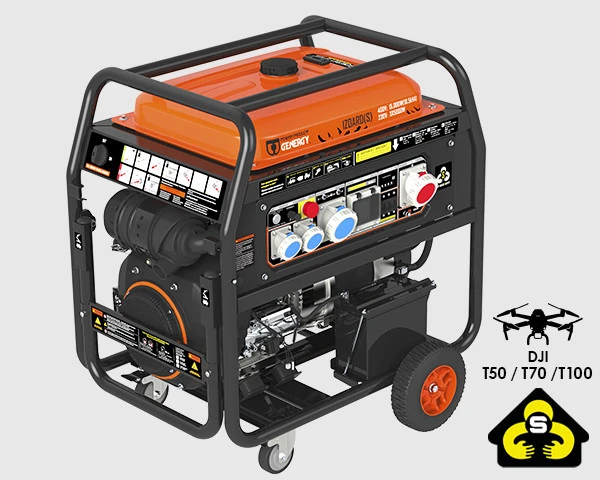
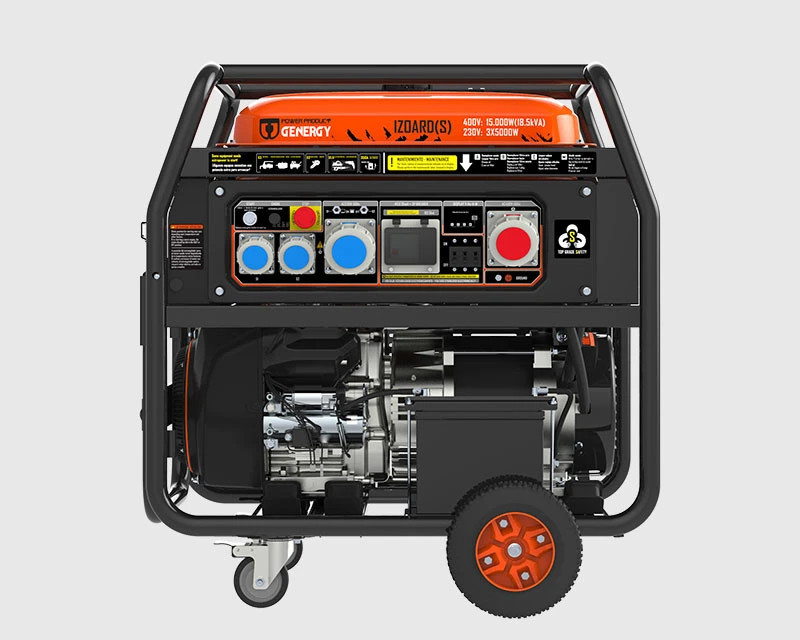
Generator for DJI Agras T50 / T70 / T100 – 15,000W – Agricultural Drone Charger
Generator for agricultural drones -
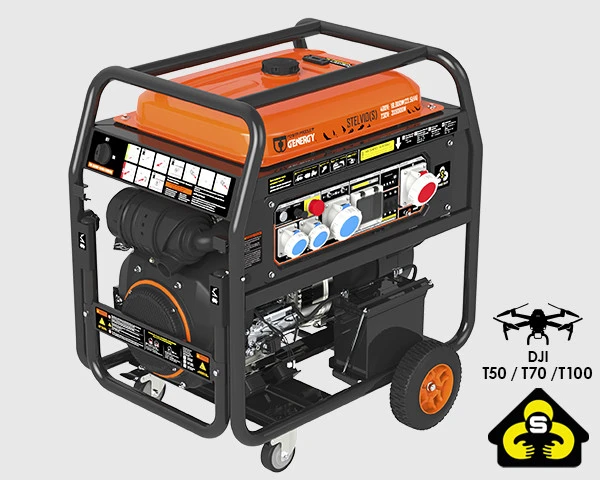
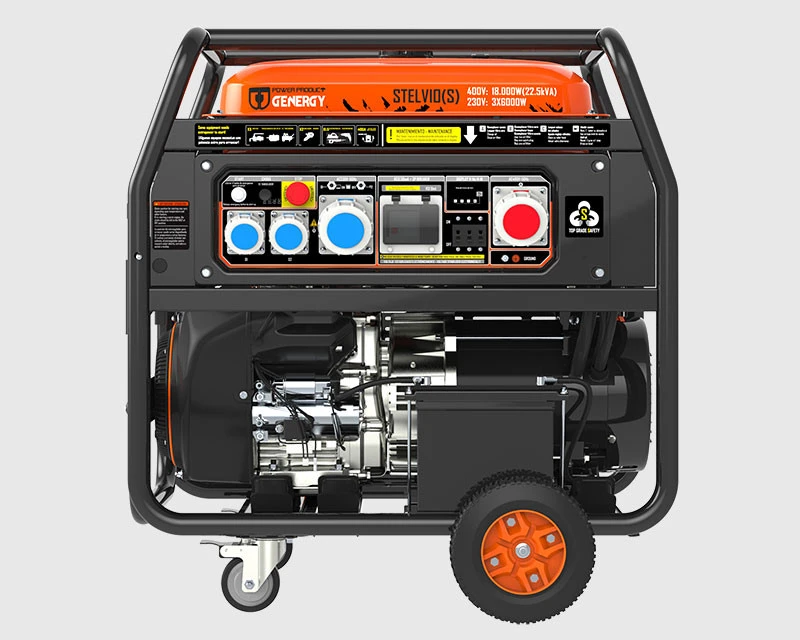 Quick View
Generator for DJI Agras T50 / T70 / T100 – 18,000W – Agricultural Drone Charger
Generator for agricultural drones -
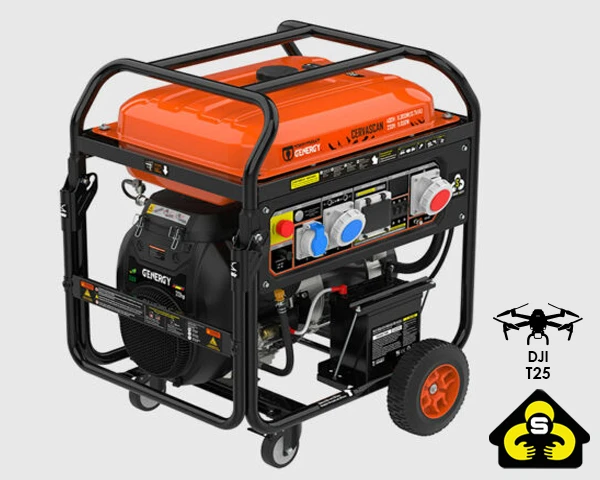
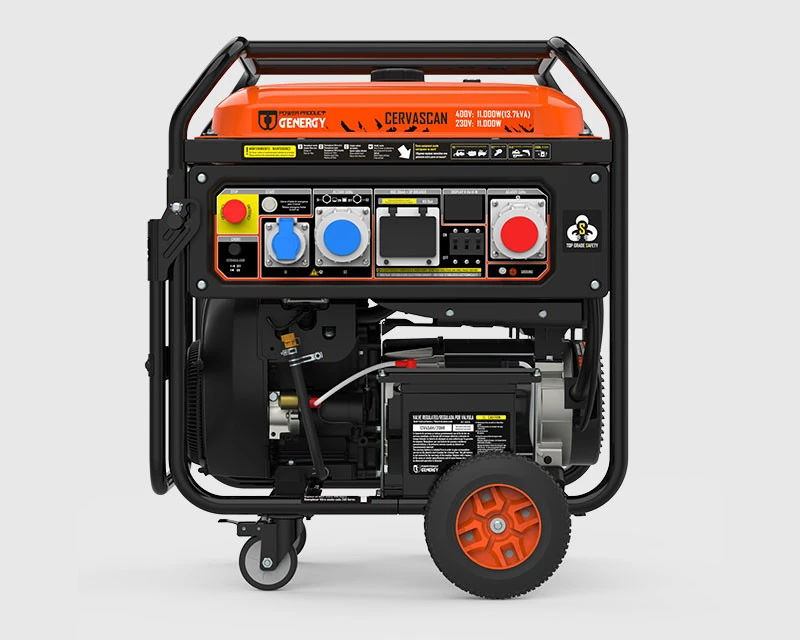 Quick View
Generator for DJI T25 11000W – Agricultural Drone Charger – CERVASCÁN-S
Generator for agricultural drones -
 Quick View
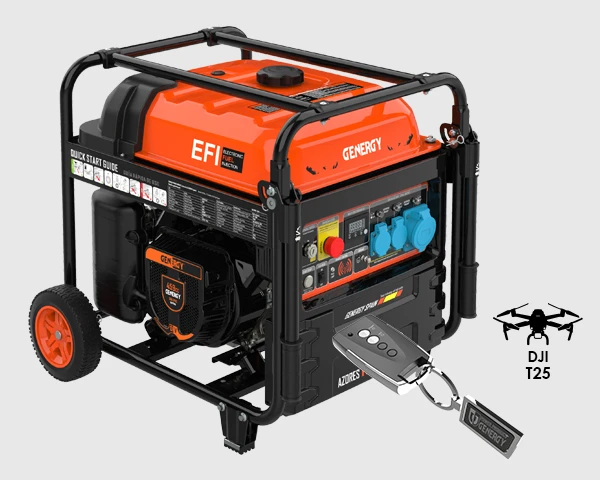
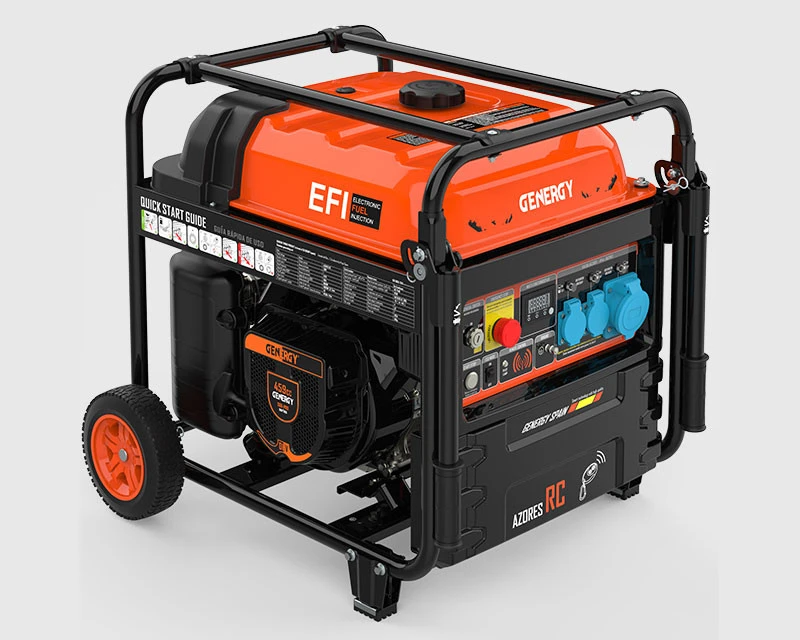
Generator for DJI T25 RC 10000W – Agricultural drone charger – Mod. Azores
Generator for agricultural drones -
-
-
-
Frequently asked questions
Can a generator be connected directly to the electrical panel?
This should only be done using equipment designed for this purpose and a system that safely isolates the generator from the grid. It should not be done haphazardly or without professional inspection.
Do you need a transfer switch to connect a generator to a house?
In practice, you need a reliable transfer or interlock system to prevent simultaneous power supply from both the grid and the generator. A transfer switch is one of the most common solutions.
What generator capacity do I need for a home?
It depends on the loads you want to back up. The right approach is to add up essential power consumption, account for startup peaks, and leave some margin. It’s not a good idea to calculate right up to the limit.
Can you plug a generator into a household outlet?
It is not a safe practice. That kind of improvisation can cause feedback, damage the equipment, and put people at risk.
Which appliances should be powered on first?
Refrigerator, freezer, basic lighting, router, water pump, or essential heating, depending on the home. First, reliability; then, comfort.
Where should the generator be placed?
In an outdoor area or a well-ventilated, stable, accessible location away from air intakes into the home. Never in enclosed or poorly ventilated spaces.
Is it worth connecting a generator without a transfer switch?
Not as a general approach. The important thing is to have a safe and reliable system in place to prevent cross-connections between the grid and the generator. Without that, it’s not worth the risk.