How much does a gasoline and diesel generator consume: calculation, examples and table
By the Genergy technical team · Spanish manufacturer of generators and generator sets (15+ years) · updated July 2026 · 11 min read.
Table of contents
- How much it really consumes
- Consumption table by fuel
- Diesel generator consumption
- Gasoline vs diesel difference
- How to calculate consumption
- Gasoline consumption per hour
- Example: 20 kVA diesel
- Key influencing factors
- How to reduce consumption
- Which generator to choose
- Genergy generators
- Frequently asked questions
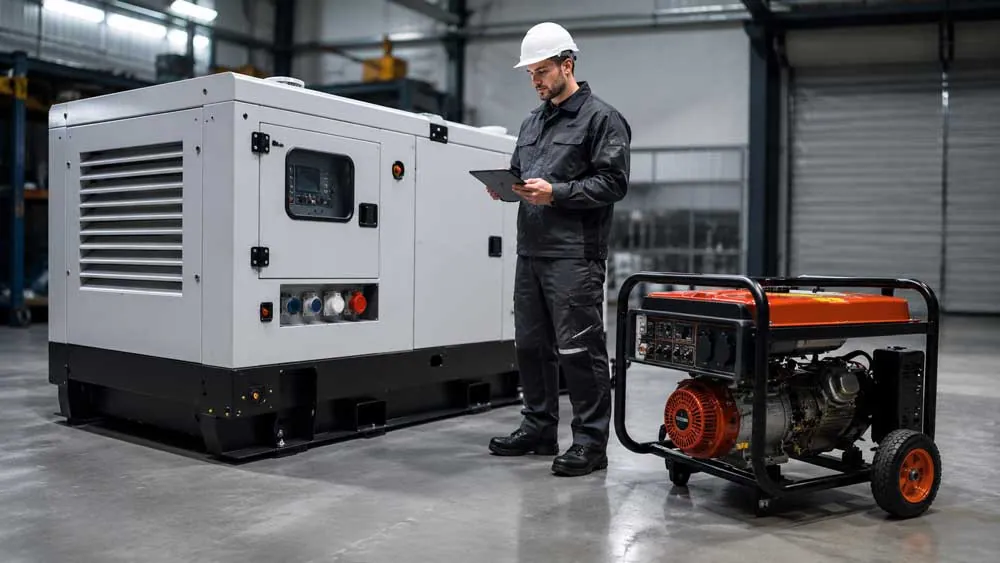
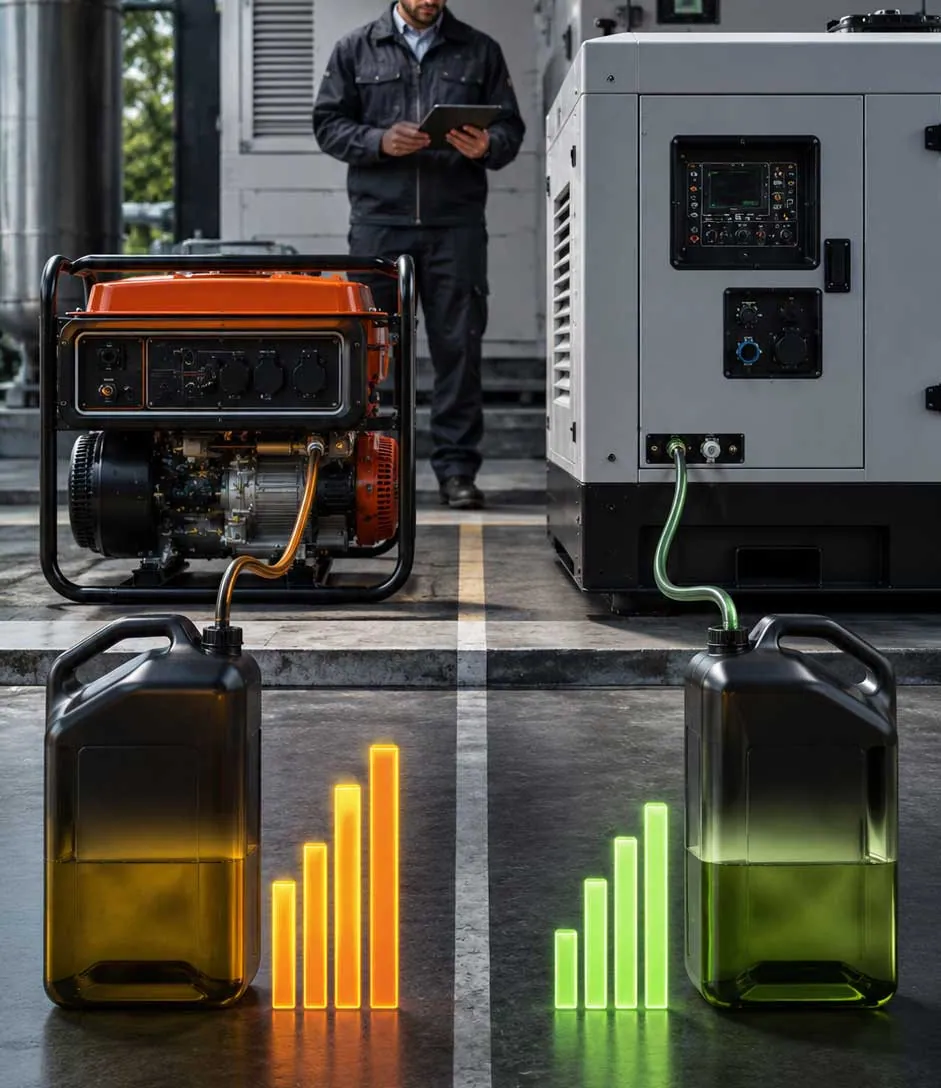
Knowing how much a gasoline and diesel generator consumes is not as simple as looking at the data sheet and settling on a fixed number. In practice, consumption depends on three things: the power of the unit, the type of fuel and, above all, the connected load at any given moment. A generator powering a small tool does not consume the same as one supplying machinery, pumps or a complete installation. As a general reference, a diesel generator is usually more efficient (0.2-0.3 liters per kW produced) and a gasoline one uses more (0.4-0.6 liters per kW). These are indicative values, but they help you make a first estimate before choosing a unit.
How much does a generator really consume?
Real consumption does not depend only on the maximum power shown on the label. A 5 kW generator does not always consume as if it were delivering 5 kW: if it works at 30%, it uses much less than at 80-100% load. That is why, when asked "how much does a generator consume", the right answer is usually: it depends on the connected load.
Buying a generator that is too large "just in case" can make it run at very low loads for long periods, which is not always efficient (especially with diesel, where running well below the recommended load increases relative consumption and maintenance). The ideal is to match the unit to its real use: for small or occasional applications, gasoline generators are a good fit; for continuous or professional use, a generator set with suitably sized power makes more sense.
Before calculating liters per hour, it is worth making a basic list: which appliances will be connected, how many watts or kW each one draws, whether they have a starting peak, how many hours they will run and whether they will all work at the same time or in shifts. This is key to avoid undersizing or oversizing.
Indicative consumption table by fuel
This is a practical reference; it does not replace the technical data sheet of each model:
| Generator type | Approx. consumption per kW produced | Typical use |
|---|---|---|
| Conventional gasoline | 0.4 – 0.6 L/kW | Occasional and household use, small tools |
| Inverter gasoline | 0.3 – 0.5 L/kW | Electronics, camping, efficient household backup |
| Diesel | 0.2 – 0.3 L/kW | Continuous use, construction sites, industry, emergencies |
| Industrial diesel | 0.2 – 0.28 L/kW | Intensive work and long shifts |
Gasoline generator consumption
A good reference is 0.4-0.6 liters per kW produced:
| Connected load | Estimated gasoline consumption |
|---|---|
| 1 kW | 0.4 – 0.6 L/h |
| 2 kW | 0.8 – 1.2 L/h |
| 3 kW | 1.2 – 1.8 L/h |
| 5 kW | 2 – 3 L/h |
| 8 kW | 3.2 – 4.8 L/h |
A gasoline generator makes sense when you need a light, easy-to-transport unit for non-continuous use (home, farm, DIY, tools or occasional emergencies). If you are going to connect sensitive electronic equipment or variable loads, an inverter gasoline generator adapts engine speed better to demand, which helps reduce consumption and noise at partial load.
Diesel generator consumption
It is usually between 0.2 and 0.3 liters per kW produced: to generate the same energy, it normally needs less fuel than a gasoline unit.
| Connected load | Estimated diesel consumption |
|---|---|
| 5 kW | 1 – 1.5 L/h |
| 10 kW | 2 – 3 L/h |
| 15 kW | 3 – 4.5 L/h |
| 20 kW | 4 – 6 L/h |
| 40 kW | 8 – 12 L/h |
The difference becomes significant when the generator runs for many hours. For occasional use, the savings may not be decisive; but on construction sites, in industry, for backup power or in off-grid installations, diesel usually pays off in efficiency and durability. For these uses, it makes sense to look at an industrial generator set.
Consumption difference between gasoline and diesel
The basic difference: gasoline consumes more per kW produced, but the units are simpler and lighter; diesel consumes less, is more robust and performs better in prolonged use; the inverter gasoline is a good option for small, variable or sensitive loads; and industrial diesel is designed for many hours with stable demand. In short: if the generator will be used little, a gasoline unit may be enough; if it will be used for many hours or under heavy load, diesel is usually the better decision.
How to calculate a generator's consumption
The formula is simple, using the actual connected load (not the generator's maximum power):
For gasoline: kW × 0.4 to 0.6 = liters/hour. For diesel: kW × 0.2 to 0.3 = liters/hour. Example: if you connect 4 kW to a gasoline generator, 4 × 0.4 = 1.6 L/h and 4 × 0.6 = 2.4 L/h → between 1.6 and 2.4 liters/hour. The same 4 kW with diesel: 4 × 0.2 = 0.8 and 4 × 0.3 = 1.2 → between 0.8 and 1.2 liters/hour. At the same load, diesel consumes considerably less.
Refrigerator 0.3 kW + lighting 0.4 kW + tool 1.5 kW + other 0.3 kW = 2.5 kW. Applying the range: 2.5 × 0.4 = 1 L/h and 2.5 × 0.6 = 1.5 L/h → it would consume between 1 and 1.5 liters of gasoline per hour. Useful for sizing the tank and knowing the real runtime.
How much does a gasoline generator consume per hour?
Typical figures range from less than 1 liter/hour in small units to several liters/hour in powerful models. The real figure depends on the load: a 7 kW generator does not always consume as if it were delivering 7 kW; with 2 or 3 kW connected, it uses less.
| Power used | Approximate gasoline consumption |
|---|---|
| 1 kW | 0.4 – 0.6 L/h |
| 2 kW | 0.8 – 1.2 L/h |
| 3 kW | 1.2 – 1.8 L/h |
| 5 kW | 2 – 3 L/h |
| 7 kW | 2.8 – 4.2 L/h |
| 10 kW | 4 – 6 L/h |
It is advisable to check the technical data sheet of the specific model: two generators with the same power can have different consumption due to engine design, efficiency, maintenance or alternator type. Gasoline is attractive when use is occasional, mobility is needed, power is not very high or the initial budget matters. And inverter generators stand out with variable loads (electronics, computers, LED lighting), where they adapt the engine better to demand.
20 kVA diesel generator consumption: a realistic example
Here we are talking about a unit for professional use, large homes, businesses or workshops. First, kVA and kW are not the same: with a power factor of 0.8, 20 kVA × 0.8 = 16 kW of approximate usable power. If you are looking in this range, the natural choice is a 20 kVA generator set.
| Scenario (diesel 20 kVA ≈ 16 kW usable) | Load | Consumption/hour | 8-hour shift |
|---|---|---|---|
| Medium load | ~8 kW | 1.6 – 2.4 L/h | 12.8 – 19.2 L |
| High load | ~16 kW | 3.2 – 4.8 L/h | 25.6 – 38.4 L |
The same 20 kVA generator can use almost twice as much when going from medium load to high load. That is why the connected load is so decisive.
Key factors that influence consumption
Besides the fuel, these factors matter: the power actually demanded (not the unit's maximum); the load percentage (the ideal is a medium-to-high range, avoiding constant 100% and ridiculously low loads); the engine and fuel type (conventional vs inverter, portable vs soundproof industrial); the quality of maintenance (air filter, oil, spark plugs on gasoline, injectors on diesel, fuel condition and ventilation); and the environmental conditions (extreme heat, poor ventilation or high altitude make the engine perform worse). An engine that breathes poorly or has degraded oil needs more fuel to produce the same energy.
How to reduce a generator's consumption
It is not just a matter of buying "the one that uses the least". Choose the right power (neither so small that it works under strain, nor so large that it runs almost empty). Avoid loads that are too low or too high: group your consumers and do not connect equipment you are not using. Check filters, oil and spark plugs/injectors, and use fuel in good condition. And switch off unnecessary consumers: every extra kW increases hourly consumption. To compare options, a good starting point is to review the generator set families by power, fuel and use.
Which generator to choose based on consumption and use
The best choice is not always the one that consumes the least in a table, but the one that best fits the real use. For occasional or household use (emergencies, small tools, sporadic jobs), a gasoline generator is usually enough. For solar backup or sensitive loads, an inverter gasoline generator provides more stable power. For professional or industrial use (long shifts, machinery, construction sites, installation backup), diesel is the most logical option: look at an industrial generator set. And for 20 kVA or more, the calculation must be done carefully: a 20 kVA generator set suits large homes, businesses or workshops, and a 50 kVA generator set is aimed at more demanding uses.
Genergy generators and generator sets
Filter by the fuel you are interested in, and remember that real consumption depends on the load you connect:
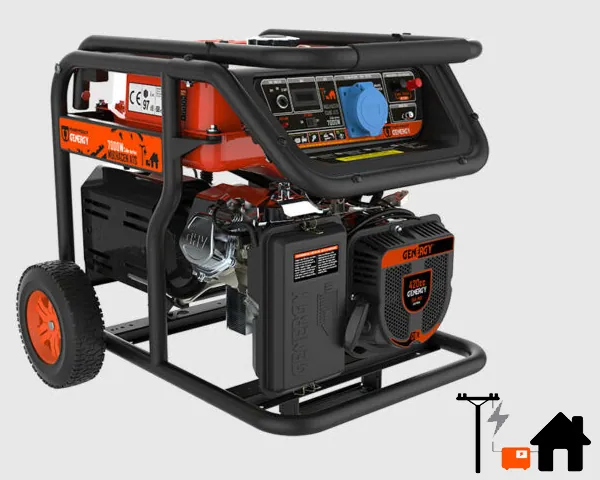
Generador Mulhacén ATS 7000W
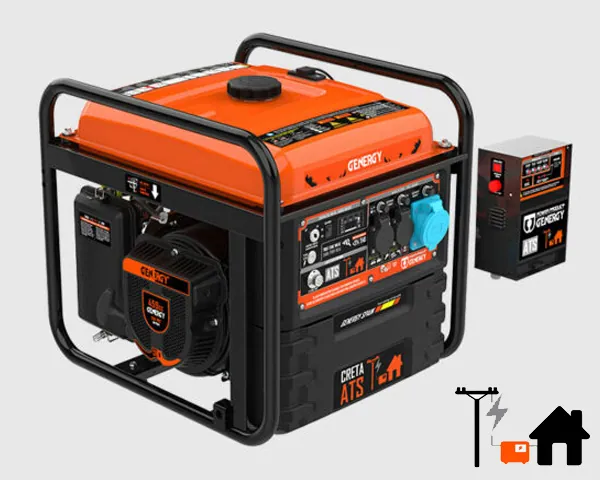
Creta ATS 7500W Generator
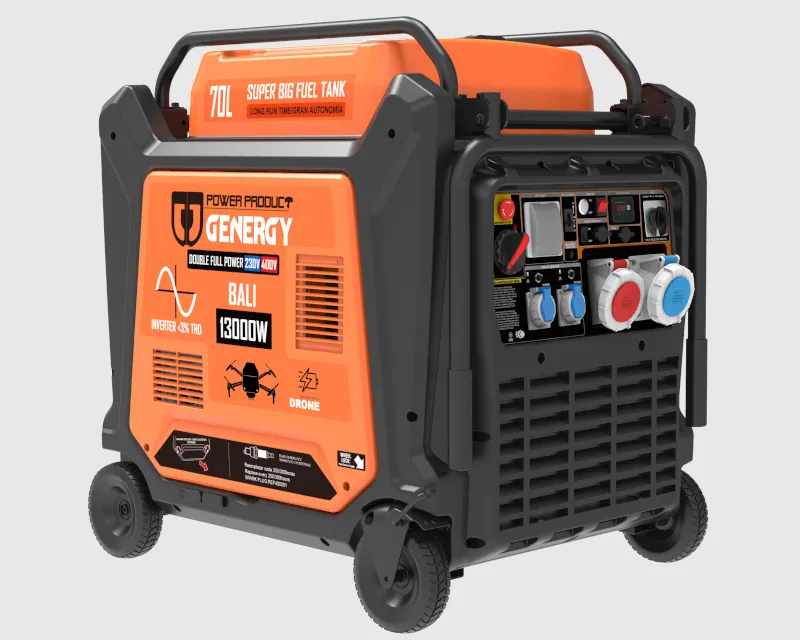
Bali RC-SOL-ATS 13000W Generator
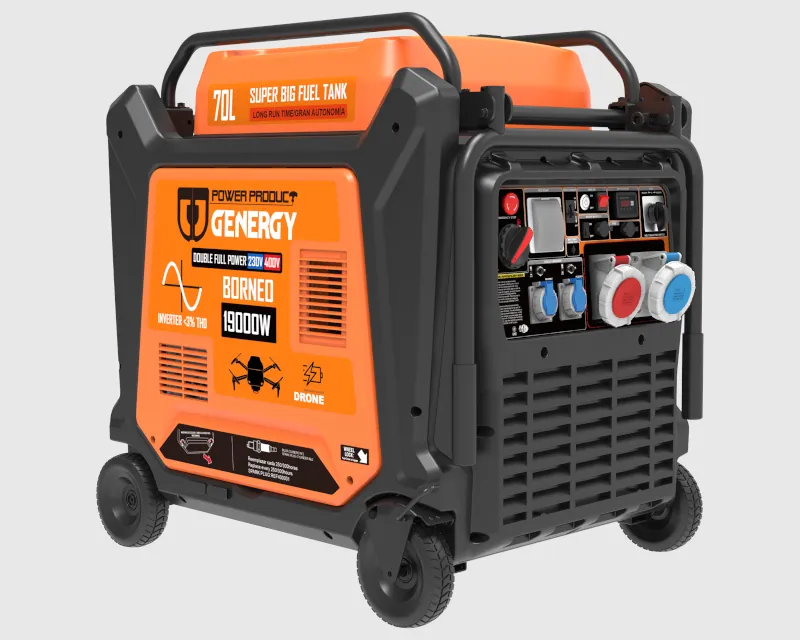
Borneo RC-SOL-ATS 19000W Generator
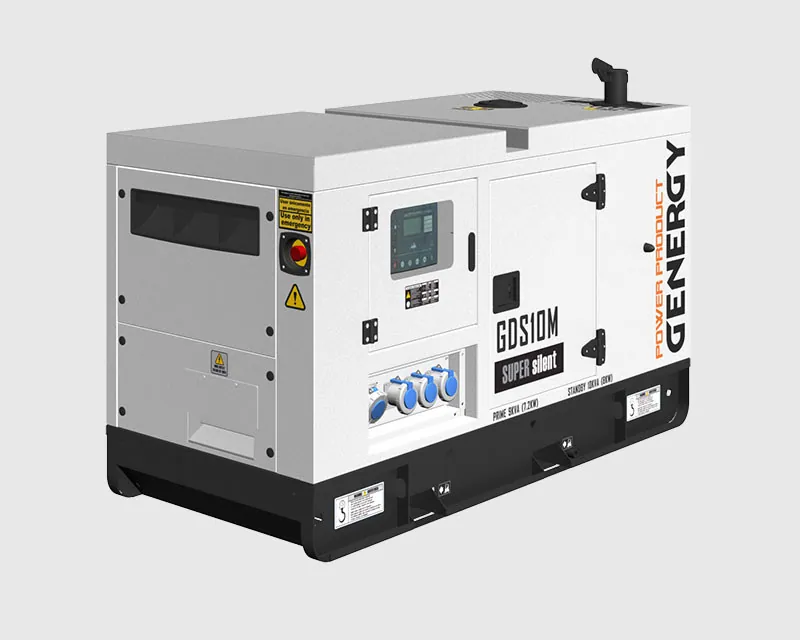
GDS10M 10 kVA Generator Set
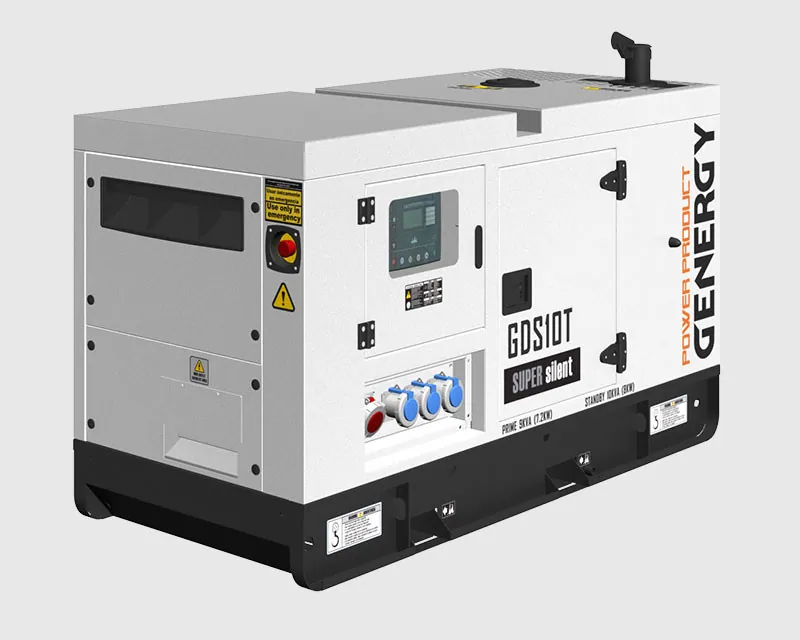
GDS10T 10 kVA Generator Set
👉 See the full range: Gasoline generators · Diesel generator sets · 20 kVA generator set · Questions? Talk to a technician.
Want to know how much your generator will use?
Tell us the kW you will connect and the hours of use, and we will help you choose between gasoline and diesel by calculating real consumption and runtime. We are manufacturers. No obligation.
Talk to a Genergy technicianConclusion: gasoline or diesel, which consumes less?
Strictly in terms of consumption, diesel usually uses less: ~0.2-0.3 liters per kW produced versus ~0.4-0.6 for gasoline. But the best choice depends on the use: for occasional jobs, mobility and moderate power, gasoline may be enough; for many hours, high loads or professional use, diesel is more cost-effective in terms of consumption, runtime and durability. The key is to calculate the actual connected load: a generator at 30% does not consume the same as at 80%. Before buying, estimate the kW you will use, the operating hours and the type of equipment you will connect.
Related categories
Related topics

Frequently asked questions about generator consumption
How much does a gasoline generator consume?
It usually consumes between 0.4 and 0.6 liters per kW produced. For example, with 3 kW connected, the approximate consumption is between 1.2 and 1.8 liters per hour.
How much does a diesel generator consume?
It usually consumes between 0.2 and 0.3 liters per kW produced. If it runs with a 10 kW load, the approximate consumption would be between 2 and 3 liters per hour.
How much does a 20 kVA diesel generator consume?
A 20 kVA diesel delivers about 16 kW usable (power factor 0.8). At medium load (about 8 kW) it can consume between 1.6 and 2.4 liters/hour; at high load (close to 16 kW), between 3.2 and 4.8 liters/hour.
Does a larger generator always consume more?
Not always. It has the capacity to consume more if more power is demanded from it, but real consumption depends on the connected load. Even so, oversizing too much can be inefficient.
Which consumes less, an inverter generator or a conventional one?
At low or variable loads, an inverter can consume less because it adapts engine operation better to demand. It is also usually quieter and better suited to sensitive electronic equipment.
How can I reduce fuel consumption?
Choose the right power (neither oversized nor at the limit), avoid running at very low or very high loads, keep the generator well maintained (air filter, oil, spark plugs or injectors, and fuel in good condition) and switch off unnecessary consumers. A well-sized and well-maintained unit uses considerably less to produce the same energy.