How much does a generator set consume: liters per hour and examples
By the technical team at Genergy · Spanish manufacturer of generators and generator sets (+15 years) · updated July 2026 · 10 min read.
Table of contents
- How much it consumes per hour
- What it depends on
- How to calculate consumption
- How to calculate the cost
- Diesel generator set consumption
- Table by power output
- How load affects consumption
- Consumption for home use
- Industrial consumption
- How to calculate runtime
- Genergy generator sets
- Frequently asked questions
Knowing how much a generator set consumes is not as simple as looking at its maximum power: actual consumption depends on the fuel, the connected load, engine efficiency, operating hours and the condition of the equipment. As a reference, a gasoline generator can consume around 0.4 to 0.6 liters for every kWh produced, while an efficient diesel generator set sits roughly between 0.20 and 0.25 liters per kWh generated. These are indicative ranges; exact consumption should be checked in the model's technical data sheet, normally expressed in liters per hour at different load percentages. The key idea: a generator set does not consume the same at 25% of its capacity as at 75% or near its maximum, which is why choosing the right power is essential.
If you are looking for the consumption of a portable gasoline or diesel generator (camping, light construction, occasional use), you will find the details in the guide how much a gasoline and diesel generator consumes. This article focuses on the generator set (diesel, kVA, professional and industrial backup, 1500 rpm).
How much a generator set consumes per hour
Hourly consumption depends on the power it is delivering at that moment. A 10 kW generator set does not have to produce 10 kW all the time: if the connected equipment only demands 5 kW, it will be at 50% load. As a guideline, a small gasoline generator can consume between 1 and 3 liters per hour; a domestic or professional diesel generator set, between 1.5 and 5 liters per hour; and an industrial generator set can easily exceed 10, 20 or more liters per hour, depending on power and load. These ranges are wide because a 3 kW portable unit is not comparable to a 100 kVA industrial generator set.
What fuel consumption depends on
The factors are the rated power (the higher the power, the higher the absolute consumption, although a large diesel can be more efficient per kWh than a small gasoline unit); the load percentage (consumption rises with load, but not in perfect proportion, and the engine burns fuel even when idle); the type of fuel (gasoline for small equipment and occasional use, diesel for professional/industrial use with better specific consumption); the engine speed (3000 rpm engines are compact and suited to occasional use; 1500 rpm engines are designed for prolonged operation, with a longer service life and better efficiency in continuous use); and condition and maintenance (clogged filters, dirty injectors or degraded oil increase consumption). If you are looking for equipment for many hours of operation, check out the range of 1500 rpm diesel generator sets.
How to calculate a generator set's consumption
If you know the specific consumption: hourly consumption = output power × specific consumption. Diesel example: 8 kW × 0.22 L/kWh = 1.76 L/h. Gasoline example: 4 kW × 0.5 L/kWh = 2 L/h. If the technical data sheet already states the liters per hour: total consumption = liters per hour × operating hours (for example, 3.5 L/h × 10 h = 35 liters).
How to calculate the economic cost
Example with a consumption of 2.5 L/h and a hypothetical reference fuel price: 2.5 × fuel price = cost/hour, and multiplied by the hours of use you get the cost of the working day. Fuel prices change over time, so update it with the current price when you do your calculation.
Diesel generator set delivering 12 kW for 6 hours, consumption 0.22 L/kWh: 12 × 0.22 = 2.64 L/h → 2.64 × 6 = 15.84 liters. Multiply those liters by the current fuel price to get the approximate cost of the working day.
Diesel generator set consumption
Diesel is usually the preferred option for frequent home backup, industry, agriculture, construction, businesses, long working days and critical installations. A common range for a preliminary calculation is 0.20 to 0.25 L/kWh. Remember that kVA and kW are not the same: with a power factor of 0.8, a generator set of X kVA delivers approximately X × 0.8 kW of usable power.
| Generator set (kVA) | Approx. usable power (kW) | Consumption at full load (0.22 L/kWh) |
|---|---|---|
| 10 kVA | 8 kW | ≈ 1.76 L/h |
| 20 kVA | 16 kW | ≈ 3.52 L/h |
| 50 kVA | 40 kW | ≈ 8.8 L/h |
These are indicative calculations that assume a high load. At partial load, hourly consumption will be lower (although efficiency per kWh may change). Diesel pays off when the equipment will run for many hours, power is medium or high, you need durability or you are looking for better specific consumption. For general applications, check the range of generator sets.
Indicative consumption table by power output
General estimates; they do not replace the technical data sheet:
| Output power | Estimated gasoline | Estimated diesel |
|---|---|---|
| 2 kW | 0.8-1.2 L/h | 0.4-0.5 L/h |
| 3 kW | 1.2-1.8 L/h | 0.6-0.75 L/h |
| 5 kW | 2-3 L/h | 1-1.25 L/h |
| 8 kW | 3.2-4.8 L/h | 1.6-2 L/h |
| 10 kW | 4-6 L/h | 2-2.5 L/h |
| 20 kW | 8-12 L/h | 4-5 L/h |
| 40 kW | 16-24 L/h | 8-10 L/h |
The table shows why diesel is usually more efficient for prolonged use.
How load affects consumption
| Load | Typical behavior |
|---|---|
| 0-25% | Low absolute consumption, but poor efficiency |
| 25-50% | Moderate consumption |
| 50-75% | Normally the efficient zone |
| 75-100% | Higher output and consumption |
| Over 100% | Overload and risk of breakdown |
The engine burns fuel even when it produces little electricity, so an oversized generator set running at 20% can be less efficient than expected. Many engines work well between 50% and 80% load. Running for long periods at very low load, especially on diesel, can cause incomplete combustion, carbon buildup and deposits, so it is advisable to size the generator set so that it usually works within an efficient range.
Generator set consumption for home use
In a home, consumption depends on which appliances are connected (refrigerator, freezer, lights, router, TV, chargers, boiler, small pump). Example with an average load of 3 kW during a blackout: with diesel, 3 × 0.22 = 0.66 L/h (≈ 5.3 liters in 8 h); with gasoline, 3 × 0.5 = 1.5 L/h (≈ 12 liters in 8 h). You do not need equipment capable of powering the whole house: it is usually more efficient to prioritize essential loads. The home generator set range lets you compare by power, fuel and backup level.
Industrial generator set consumption
In industry, consumption must be calculated precisely, because small differences turn into large costs when running for many hours. An industrial generator set can power production lines, pumps, cold rooms, machinery, lighting and critical equipment. Example: if it consumes 10 L/h and runs 12 hours, that is 120 liters/day; over 22 days, 2,640 liters/month. That is why efficiency and sizing are essential. For higher power, consider an industrial generator set designed for professional and continuous operation. 1500 rpm diesel generator sets are the most suitable for intensive use thanks to their lower wear and longer service life compared with 3000 rpm units (more compact, but for occasional use).
How to calculate runtime
Examples: a 20-liter tank with a consumption of 2 L/h gives 10 hours; a 100-liter tank at 8 L/h gives 12.5 hours. It is advisable to leave a margin and not plan on running the tank down to the very end. To reduce consumption: choose the right power (neither oversized nor overstretched), keep an efficient load, switch it off when it is not needed, carry out maintenance (oil, filters, cooling, injection, fuel, battery), connect large loads in stages to avoid peaks and, in hybrid installations, combine it with solar or batteries so that it runs only when needed.
Genergy diesel generator sets
Our GDS range of diesel generator sets is designed for professional backup and continuous use. Filter by what you need: single-phase (home, business) or three-phase (industry, machinery):
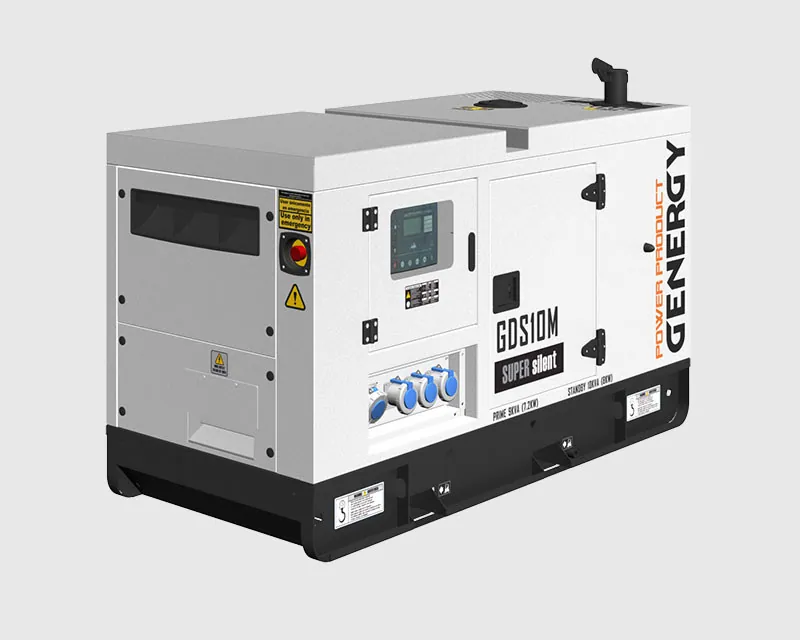
GDS10M 10 kVA generator set
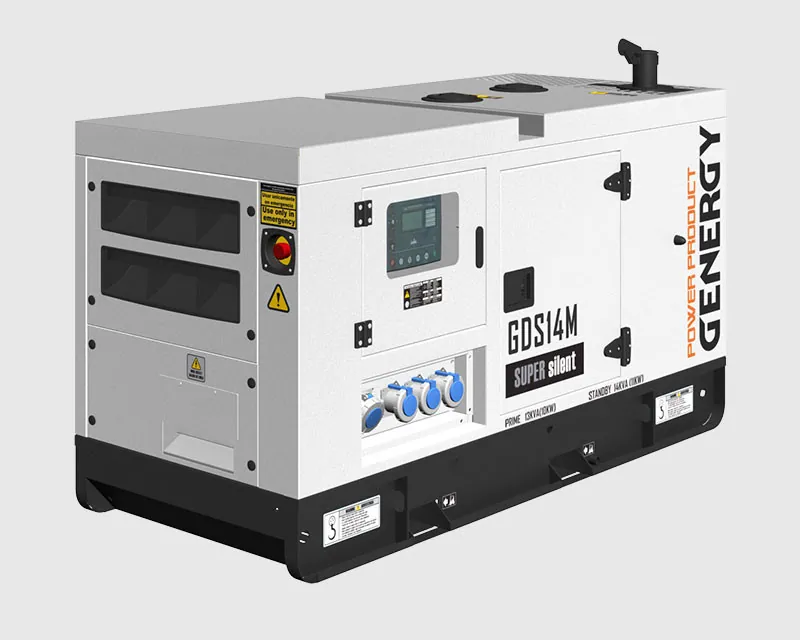
GDS14M 14 kVA generator set
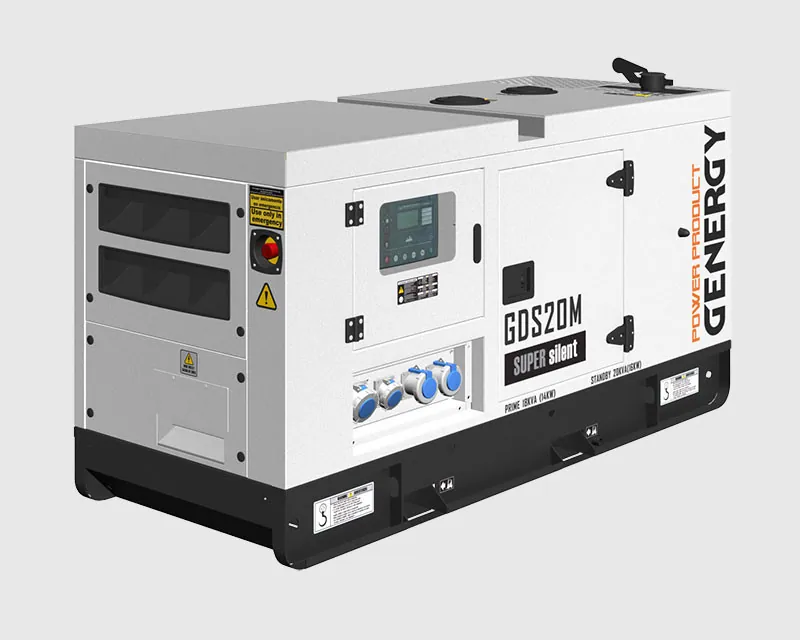
GDS20M 20 kVA generator set
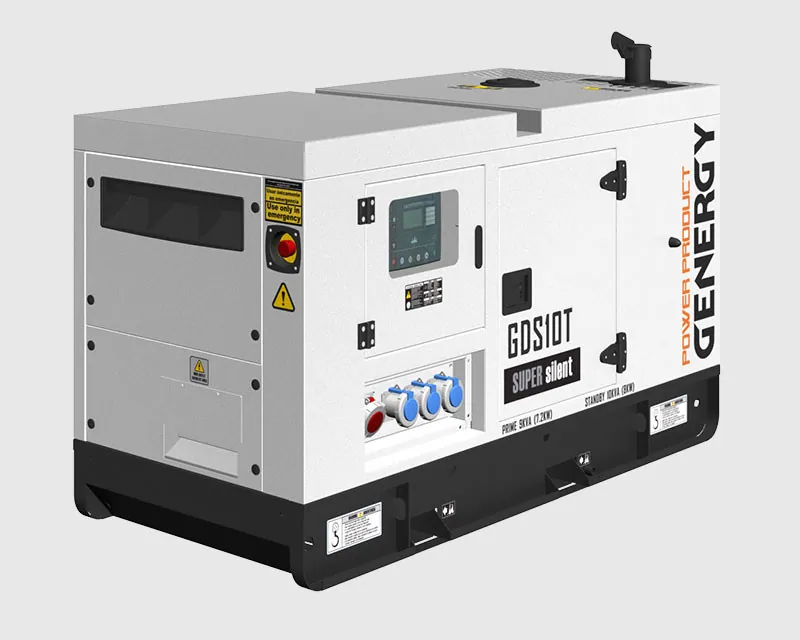
GDS10T 10 kVA generator set
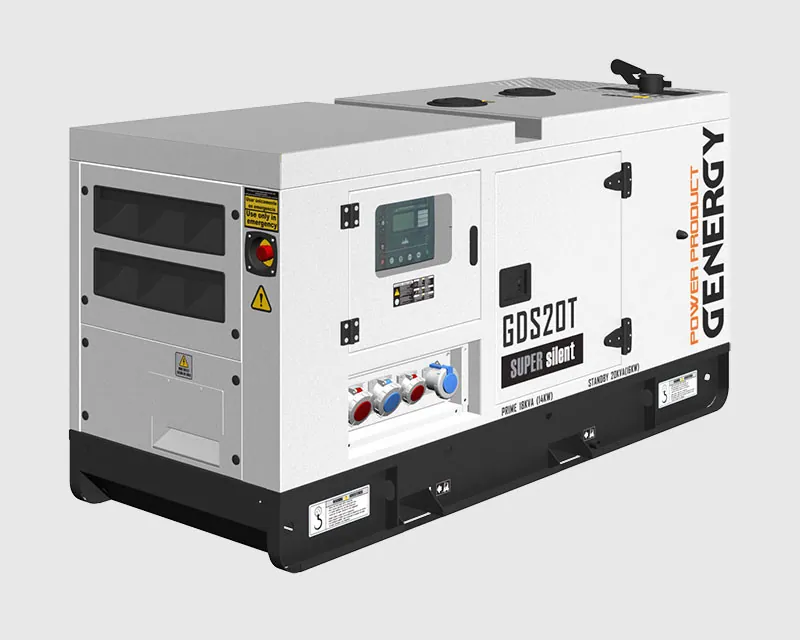
GDS20T 20 kVA generator set
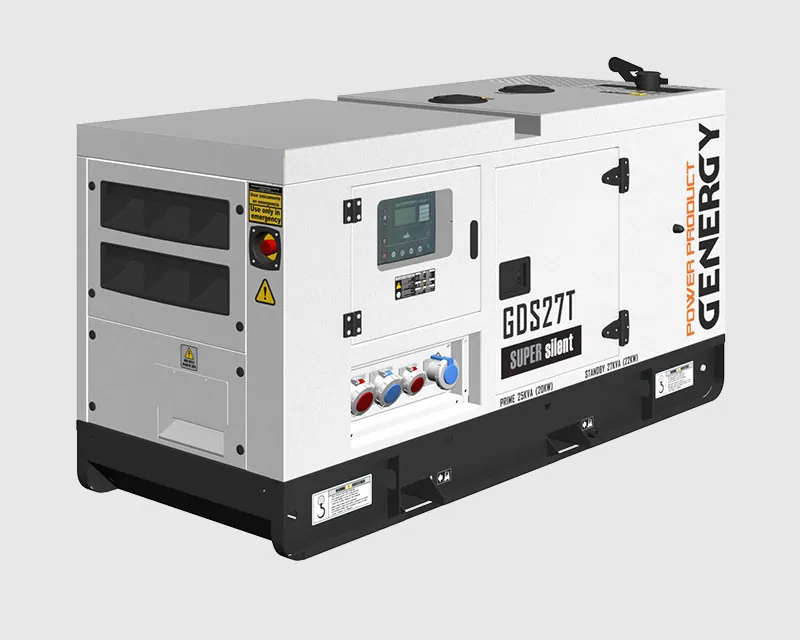
GDS27T 27 kVA generator set
👉 See the full range: 1500 rpm diesel generator sets · Industrial generator set · Home generator set · Questions? Talk to a technician.
Want to know how much your generator set will use?
Tell us the power you will connect and the hours of use, and we will help you choose the diesel generator set with the best consumption and runtime for your case. We are the manufacturer. No obligation.
Talk to a Genergy technicianConclusion
To know how much a generator set consumes, you need to know the power it is delivering, the fuel and the load percentage. As a reference: gasoline ≈ 0.4-0.6 L/kWh and diesel ≈ 0.20-0.25 L/kWh. A gasoline unit may be enough for small, occasional uses; a diesel generator set is usually more efficient for prolonged, professional or industrial use. The best way to reduce consumption is not to buy the smallest unit, but to choose a power rating that lets you work with headroom within an efficient load range. Before deciding, always check the manufacturer's consumption at different loads and calculate liters/hour, daily hours, fuel price, tank runtime and maintenance cost.
Related categories
Related topics
Frequently asked questions about generator set consumption
How many liters does a generator set consume per hour?
It can range from less than one liter in small units to tens of liters in industrial generator sets. It depends on the output power and the load percentage, as well as the fuel.
How much does a 5 kW generator consume?
As a guide, a gasoline unit would consume between 2 and 3 L/h at full load (5 kW × 0.4-0.6 L/kWh), and a diesel one between 1 and 1.25 L/h (5 kW × 0.20-0.25 L/kWh). At partial load, less.
How much does a 10 kVA generator set consume?
A 10 kVA generator set delivers about 8 kW of usable power (power factor 0.8). On diesel, at full load it would be around 1.76 L/h (8 × 0.22 L/kWh); at half load it would consume considerably less per hour.
Which consumes less, gasoline or diesel?
In liters per kWh generated, diesel usually consumes less (≈ 0.20-0.25 L/kWh versus ≈ 0.4-0.6 for gasoline). The difference is most noticeable in uses of many hours.
How much does it cost to keep it running for 8 hours?
Multiply the hourly consumption by the current fuel price and by 8 hours. For example, with 2.5 L/h: 2.5 × fuel price × 8 h = approximate cost of the working day. Always update the fuel price.
How do I know how long the tank will last?
Divide the tank capacity by the hourly consumption. For example, a 20-liter tank with a consumption of 2 L/h gives about 10 hours of runtime. It is advisable to leave a margin and not run it completely dry.
Does it consume less at 50% load?
In liters per hour, yes, it consumes less than at 100%. In addition, the 50% to 80% range is usually the most efficient. At 25% it uses little in absolute terms, but makes poorer use of fuel per kWh.
Is it bad to run a diesel generator set at low load?
Running it for a long time at very low load can cause incomplete combustion, carbon buildup and deposits, as well as poorer performance. It is advisable to size it so that it works in a medium-to-high range.
Which generator set is best for continuous use?
For continuous or prolonged use, a 1500 rpm diesel generator set is recommended, thanks to its lower wear, longer service life and better behavior over long working days compared with 3000 rpm units.