How to charge a DJI Agras in the field: complete guide to working without interruptions
By the Genergy technical team · Spanish manufacturer of generators and charging systems for agricultural drones (+15 years) · updated July 2026 · 5 min read.
Table of contents
The DJI Agras T25, T50, T70 and T100 agricultural drones can treat large areas with maximum efficiency, but their productivity depends entirely on the energy available in the field. The biggest bottleneck in real operations is not the drone, but battery charging: without a suitable power system, you get downtime between flights, interruptions and a risk of damaging the chargers. In this guide you will see how to charge a DJI Agras in the field safely, continuously and professionally.
What a DJI Agras needs to charge batteries in the field
The power requirements for charging a DJI Agras in the field are:
- Source: 220–240 V single-phase (or 400 V three-phase on the larger models).
- Power: from 8 kW to 18 kW depending on the drone model.
- Type of current: stable and regulated, so as not to damage the chargers.
- Typical use: continuous charging throughout the working day on the farm.
The recommended solution is a professional drone generator designed specifically for charging agricultural drones, with smart voltage regulation and protection for chargers and batteries.
Required power and recommended generator by DJI Agras model
| Model | Minimum power | Recommended power | Recommended Genergy generator |
|---|---|---|---|
| DJI Agras T25 | 8,000 W | 10,000–11,000 W | Azores RC 10000W · Cervascán-S 11000W |
| DJI Agras T50 | 12,000 W | 15,000 W | Izoard 15000W |
| DJI Agras T70 | 12,000 W | 15,000–18,000 W | Izoard 15000W · Stelvio 18000W |
| DJI Agras T100 | 15,000 W | 18,000 W | Stelvio 18000W |
Power alone is not enough: the current must be stable and regulated. Generators dedicated to drones incorporate smart voltage regulation (SVR) to protect DJI chargers, something a cheap conventional generator does not guarantee.
Generators for DJI Agras
The whole range is designed for charging agricultural drones, with electric start, voltage regulation (SVR) and IP67 protection on the field versions. Filter by your drone model:
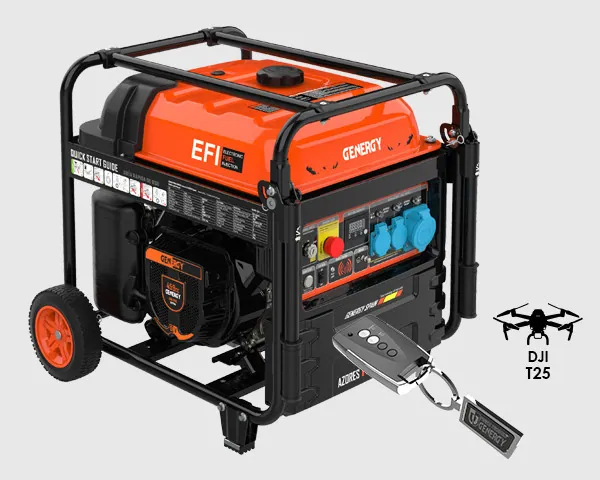
Azores RC 10000W
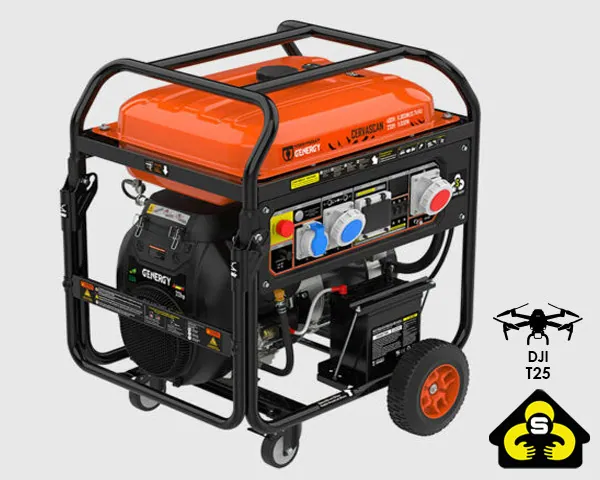
Cervascán-S 11000W
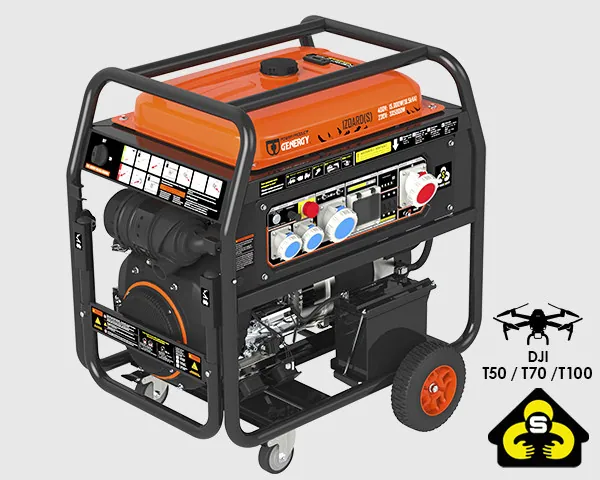
Izoard 15000W
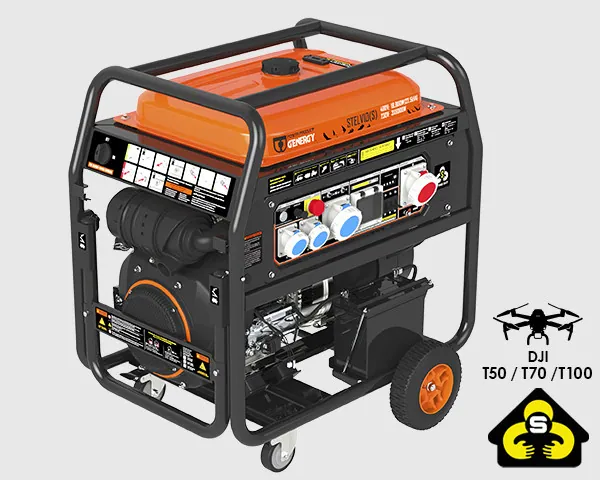
Stelvio 18000W
👉 See the full range of generators for agricultural drones. Not sure which one suits your operation? Talk to a technician.
Which generator does your drone operation need?
Tell us which DJI Agras model you work with and how many batteries you rotate, and we will recommend the generator that keeps your working day at 100%, with no interruptions.
Talk to a Genergy technicianHow many batteries you can charge simultaneously
| Generator power | Simultaneous chargers | Recommended use |
|---|---|---|
| 10 kW | 1 | DJI Agras T25 |
| 11 kW | 1 | DJI Agras T25 professional |
| 15 kW | 1–2 | DJI Agras T50 / T70 |
| 18 kW | 2+ | DJI Agras T50 / T70 / T100 intensive |
Field setup and work cycle
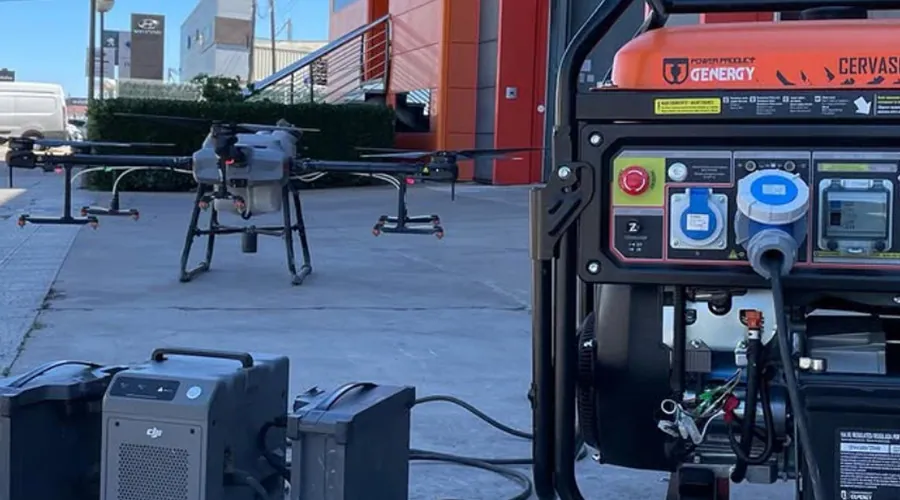
The recommended professional field setup combines a dedicated generator, the DJI Agras charger, rotation batteries and a protected charging station. With that foundation, the optimal operating cycle is simple:
- 1 battery in flight (the drone at work).
- 1 battery charging on the generator.
- 1 battery ready for the swap.
With this rotation system (minimum 3 batteries) you get continuous operation throughout the working day, with no waiting between flights.
Common mistakes when charging agricultural drones
Using an undersized generator
A low-power generator charges slowly, causes charger faults and can cause electrical damage. Always size above the minimum power of the model.
Using unstable current
Unregulated current can permanently damage chargers and shorten battery life. That is why a generator with voltage regulation (SVR) designed for this kind of charging is advisable.
Conclusion
To charge DJI Agras drones in the field and ensure continuous operation, a dedicated professional generator is the reliable solution: it provides the power and stable current the chargers need, and with a battery rotation system it eliminates downtime. Choose the power according to your model (10–11 kW for T25, 15 kW for T50/T70, 18 kW for T100) and prioritize voltage regulation and protection so you can work in the field without surprises.
Related categories
Related topics
Frequently asked questions
What generator do I need to charge a DJI Agras?
It depends on the model: for the DJI Agras T25, between 10,000 and 11,000 W; for the T50 and T70, about 15,000 W; and for the T100, 18,000 W. In addition to power, the generator must deliver a stable, regulated current to protect the chargers.
Can a DJI Agras be charged with any generator?
No. It must provide sufficient power for the model and, above all, a stable, regulated voltage. An undersized generator or one with unstable current charges slowly and can damage the drone's chargers and batteries.
What generator does a DJI Agras T50 need?
For the DJI Agras T50, a 15,000 W generator is recommended (minimum power 12,000 W), such as the Izoard model, which lets you charge one or two batteries at a time with stable current and IP67 protection for field work.
What generator does a DJI Agras T100 need?
The DJI Agras T100 needs an 18,000 W generator (minimum 15,000 W), such as the Stelvio model, capable of powering high-demand loads and several simultaneous chargers for intensive operation without interruptions.
Is an inverter or a conventional generator better for charging the drone?
What matters is not so much inverter versus conventional, but that it is a professional generator with sufficient power and stable voltage regulation (SVR). That stability is what protects DJI chargers and ensures fast, safe charging.
How many batteries do I need to work continuously?
The usual setup is a minimum of three batteries in a rotating system: one in flight, one charging and one ready for the swap. This way the drone never waits and you make the most of the whole working day with no downtime.
How many batteries can I charge at once?
It depends on the generator's power: a 10–11 kW unit charges one charger (ideal for the T25); a 15 kW unit, one to two (T50/T70); and an 18 kW unit, two or more for intensive use with the T50, T70 or T100.
Does it work for field work in rain or dust?
Yes. The professional drone versions feature IP67-rated sockets, a residual current device and a reinforced frame with transport wheels, designed for work between plots and in demanding field conditions.